Σάββατο 8 Απριλίου 2017

Communicating the Museum 2017: “The Power of Education” | France

Venue: Several locatins, Paris, France

The 2017 edition of the Communicating the Museum conference, entitled “The Power of Education”, will be held in Paris, France, on 19-22 June. Over four days, 300 museum professionals will debate the changing role of education today, discussing new ideas and forging new partnerships.
The conference aims to help participants to navigate the changing powers of education: as part of their communications strategy, as a catalyst for fundraising, or as a fundamental part of their museum’s social mission. Experts from across the museum sector and the worlds of science, academia and business will gather to share their knowledge and experience. Together, they will discuss the many forms that education now takes: from audio guides to community outreach, digital debates or special exhibitions.
Key questions addressed in the conference will include the following:
  • What is the role of museums in today’s political and social issues?
  • How to address the needs of your community?
  • How do you get educators, curators and communicants to work together?
  • How can museums learn from their public?
  • How can museum transform the field through learning, community building, and innovative practice?
The programme of the event includes a wide range of keynote addresses, workshops, masterclasses and case studies, as well as events held in several of Paris’ major museums and galleries, including Museée du Louvre, Grand Palais, Palais de Tokyo.
The conference in Paris marks the 18th edition of Communicating the Museum, which returns to the city where the event was held for the first time, in 2000. Since then, successive editions have been held in 14 different cities, including New York, Sydney, Stockholm, Venice and Istanbul.
Communicating the Museum 2017 is organised by communications agency Agenda, in partnership with Musée du Louvre, Reunión dels musées nationaux – Grand Palais, and Monnaie de Paris. Other conference partners include the International Council of Museums (ICOM) and the Network of European Museum Organisations (NEMO).
For additional information and registration, please visit http://www.agendacom.com/communicating-the-museum-2017-paris/
πηγή http://asemus.museum

Ελβετία: Αριστουργήματα της Συλλογής Μπίρλε στο Ίδρυμα Ερμιτάζ

Ελβετία: Αριστουργήματα της Συλλογής Μπίρλε στο Ίδρυμα Ερμιτάζ
Πηγή: Wikimedia Commons/ΦΩΤΟ ΑΡΧΕΙΟΥ
Το Ίδρυμα Ερμιτάζ στη Λωζάνη εγκαινιάζει έκθεση με τα εξαιρετικά έργα της Συλλογής Μπίρλε και θα διαρκέσει έως και τις 29 Οκτωβρίου. Στην παρουσίαση συμπεριλαμβάνονται έργα ιμπρεσιονιστών και μεταϊμπρεσιονιστών ζωγράφων και αριστουργήματα του 19ου και 20ου αιώνα όπως το «Λιβάδι με παπαρούνες» (Μονέ), «Το αγόρι με το κόκκινο γιλέκο» (Σεζάν) και «Ο σπορέας, ηλιοβασίλεμα» (Βαν Γκογκ).
Ο έμπορος όπλων της Ζυρίχης Εμίλ Μπίρλε (1890-1956) αγαπούσε κυρίως τους γάλλους ιμπρεσιονιστές: 54 πίνακες ζωγραφικής από τη συλλογή του που υπογράφονται από τους Ρενουάρ, Ντεγκά, Σεζάν, Μονέ, Πισαρό, Σισλέ και Βαν Γκογκ, κοσμούν το Ίδρυμα Ερμιτάζ, όπως αναφέρεται στο ΑΠΕ-ΜΠΕ.
Ωστόσο, επειδή η προέλευση ορισμένων από τα έργα που εκτίθενται για πρώτη φορά στην ελβετική πόλη αποτελεί θέμα αντιπαράθεσης στην Ελβετία, το Ερμιτάζ αφιερώνει μια ολόκληρη αίθουσα σε αρχειακά έγγραφα και στα αποτελέσματα ενδελεχούς έρευνας που διεξάγει τα τελευταία 12 και πλέον χρόνια το 'Ιδρυμα Μπίρλε, επιτρέποντας στο κοινό να καταλάβει καλύτερα την προέλευση των έργων και την ιστορική διαδρομή, περίπλοκη μερικές φορές, ορισμένων αριστουργημάτων της Συλλογής Μπίρλε, κυρίως αυτών που αποκαλύφθηκε ότι είχαν λεηλατηθεί.
"Δεν πρέπει να τιμωρούμε τα έργα λόγω του παρελθόντος τους, ένα μουσείο δεν είναι δικαστήριο αλλά χώρος μνήμης", εκτιμά η Σιλβί Βίρμαν, διευθύντρια του Ιδρύματος Ερμιτάζ. Ο ρόλος μας ως ιδρύματος είναι επίσης διδακτικός, θέλουμε να ευαισθητοποιήσουμε την κοινή γνώμη για τα έργα τέχνης που λεηλατούνται, να την καταστήσουμε πιο προσεκτική στη μερικές φορές περίπλοκη διαδρομή ορισμένων έργων τέχνης", αναφέρει στις στήλες της εφημερίδας Le Temps.
Ο Εμίλ Μπίρλε αγόραζε μανιωδώς έργα τέχνης, όπως δείχνει ο κατάλογος της έκθεσης που εκδίδει για πρώτη φορά έναν πίνακα με τα 633 έργα που περιήλθαν στην κατοχή του βιομήχανου κατά τη διάρκεια της ζωής του καθώς και τα ονόματα των πωλητών κα τις τιμές πώλησης.
Το μεγαλύτερο μέρος της συλλογής αγοράστηκε μετά τον πόλεμο, μεταξύ 1951 και 1956.
Σήμερα, πρόεδρος του Ιδρύματος Μπίρλε είναι ο Κρίστιαν Μπίρλε, εγγονός του συλλέκτη.
Μέχρι το 2015, η Συλλογή Μπίρλε εκτίθετο σε μουσείο της οικογένειας στη Ζυρίχη. Στο μουσείο, που βρίσκεται εντός της πρώην κατοικίας Μπίρλε, είχε γίνει διάρρηξη το 2010. Ένοπλοι άνδρες έκλεψαν τέσσερα αριστουργήματα, μεταξύ τους "Το αγόρι με το κόκκινο γιλέκο" του Σεζάν. Οι πίνακες βρέθηκαν στη συνέχεια.
Μετά τη Λωζάνη, η Συλλογή Μπίρλε θα ταξιδέψει στην Ιαπωνία, πριν εγκατασταθεί έως το 2020 στη νέα πτέρυγα του μεγάλου μουσείου Kunsthaus της Ζυρίχης.
αναδημοσίευση από http://www.cnn.gr
Pink Floyd Adapts George Orwell’s Animal Farminto Their 1977 Concept Album, Animals (a Critique of Late Capitalism, Not Stalin)


Pink Floyd will always be known for their massively successful concept albums, and David Gilmour and Roger Waters’ tense, and personally explosive, dynamic on albums like Dark Side of the Moon seems reminiscent of another masterful songwriting duo known for rock high concepts. Indeed, “there would have been no Dark Side of the Moon, and no dragons-and-warlocks-themed prog-rock epics,” writes Jody Rosen at Slate, “had the Beatles not decided to don epaulets for their lark of an album cover and impersonate a vaudeville band.”
But where The Beatles’ loose conceptual masterpieces had their stormy and sad moments, they generally kept things chipper on albums like Sgt. Pepper’s. Pink Floyd seemed determined to do precisely the opposite, setting a template for entire genres of metal to follow. 1977’s Animals especially reminds me of nothing so much as an album by Megadeth or Mastodon. Musical and thematic similarities abound: epic, booming, doomy songs with lyrics completely uninterested in charming their listeners. “Sheep,” for example, contains a modified version of the 23rd Psalm: “The Lord is my shepherd. He maketh me to hang on hooks in high places and coverteth me to lamb cutlets.”

As the brutish title alerts us, Animals is an adaptation of George’s Orwell’s Animal Farm (and the origin of Pink Floyd’s giant inflatable pig). The schematic allegory of Orwell’s book lends a high degree of coherence to Waters’ extended songs—only five in total. But he supplies his own characteristic bile (he famously spit on a fan during one tour, an incident that inspired The Wall). It couldn’t be more appropriate. Where Orwell’s novel is a transparent attack on Stalinism, Waters adapts his critique to “the economic and ideological systems within late-twentieth century liberal democracies.” So argues Phil Rose in an in-depth study of Waters’ lyrical ideas. The album’s “primary concern… is to reveal the effects that technocratic capitalist relations have on the nature of human beings and the evident divisions that undemocratic structures of power create among us as individuals.”
Orwell showed the effects of “undemocratic structures” by reducing individuals to animal types, and so does Waters, simplifying the classes further into three (and leaving out humans altogether): the ruling pigs, praetorian and aspiring capitalist dogs, and the sheep, the mindless masses. The opener, “Pigs on the Wing (Part One)” (top), an urgent acoustic strummer that gets picked up at the end of the album in a strangely upbeat reprise, sets a dystopian tone with images that may now seem old hat (bear in mind Animals debuted five years before Blade Runner).
If you didn’t care what happened to me,
And I didn’t care for you,
We would zig zag our way through the boredom and pain
Occasionally glancing up through the rain.
Wondering which of the buggers to blame
And watching for pigs on the wing.
Most of the songs began their lives as a rough collection that came together after Dark Side of the Moon and Wish You Were Here. Waters insisted on the literary conceit, against Gilmour’s objections, but the themes had already been very much on his mind. “Dogs,” above, was once a sardonic rant called “You’ve Gotta Be Crazy,” and one of its bleakest stanzas survives from that earlier track:
You gotta keep one eye looking over your shoulder.
You know it’s going to get harder, and harder, and harder as you
get older.
And in the end you’ll pack up and fly down south,
Hide your head in the sand,
Just another sad old man,
All alone and dying of cancer.
There may be no sharper an antithesis to “When I’m 64.” The image is made all the more devastating by the homicidal paranoia surrounding it. Not all of the Orwell overlay works so well, but when it does, it does so with devastating force. Consider these lines from “Sheep,” as terrifying as any late Medieval judgement scene, and more effective for an age that may not believe in hell but has seen the slaughterhouses:
What do you get for pretending the danger’s not real.
Meek and obedient you follow the leader
Down well trodden corridors into the valley of steel.
What a surprise!
A look of terminal shock in your eyes.
Now things are really what they seem.
The band’s “bleakest studio album,” argues Brice Ezell at Consequence of Sound, “feels eerily relevant in these grave times.” I can’t help but agree. Pink Floyd greatly inspired much of the heavy music to follow, doing as much as Black Sabbath or Led Zeppelin, I’d argue, to engage the imaginations of metalheads and prog-rock storytellers. Much of the music that followed them sounds very dated, but forty years after its release, their gloomiest record—which is saying a lot—seems more relevant than ever. Animals ends on an ambivalent note, hopeful but wary. The pigs are still on the wing, and the only remedy at hand, Waters suggests in the last few lines, may be to “know that I care what happens to you / And I know that you care for me.”
αναδημοσίευση από http://www.openculture.com

Πέμπτη 6 Απριλίου 2017

EU Prize for Cultural Heritage / Europa Nostra Awards 2017: 29 winners from 18 countries announced

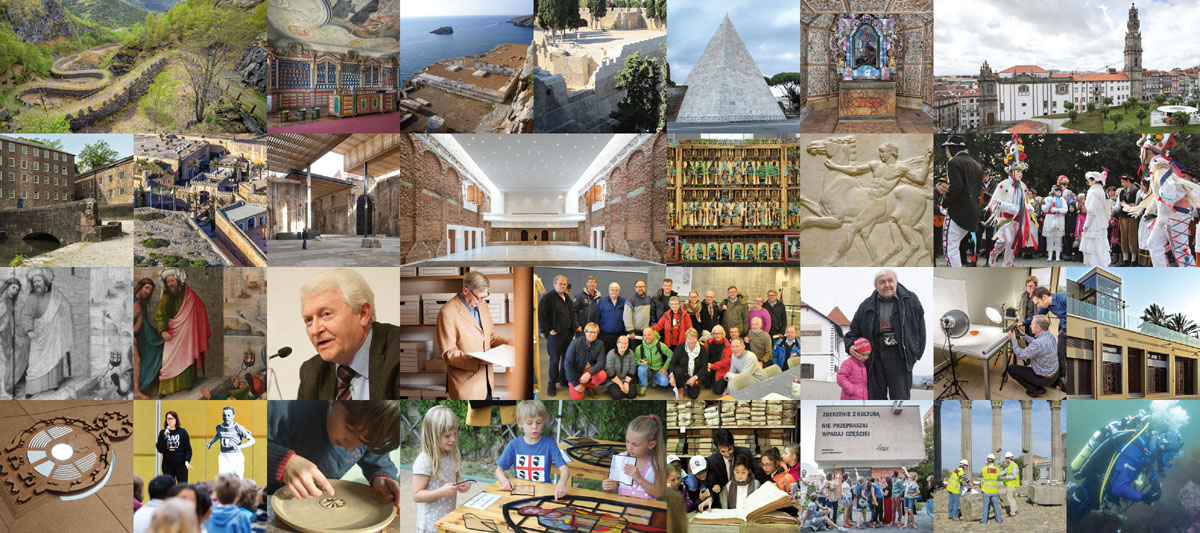
Brussels / The Hague, 5 April 2017 – The European Commission and Europa Nostra revealed today the winners of the 2017 European Union Prize for Cultural Heritage / Europa Nostra Awards, Europe’s top honour in the heritage field. The 29 laureates from 18 countries are being recognised for their notable achievements in conservation, research, dedicated service, and education, training and awareness-raising. Independent expert juries examined a total of 202 applications, submitted by organisations and individuals from 39 countries across Europe, and chose the winners.
Citizens from around the world can now vote online for the Public Choice Award and rally support for the winning project(s) from their own or another European country. Voters have the chance to win a trip for two to Finland and be a special guest at the Awards Ceremony that will be held in the historic city of Turku on 15 May. During the ceremony, the seven Grand Prix laureates, each of whom will receive €10,000, and the Public Choice Award winner, chosen from among this year’s winning projects, will be announced.
EU Prize for Cultural Heritage/Europa Nostra Awards 2017. Photo: Europa Nostra
Among the outstanding initiatives awarded this year are: the renovation of a road stretching across 100km of Norwegian mountains that has made an area of breathtaking natural beauty accessible to visitors; a pioneering research project on the paintings and drawings of the Dutch painter Hieronymus Bosch that has shed new light on some of the world’s most fascinating works of art created at the turn of the 16th century; the efforts of a conservator and art historian to protect Croatia’s heritage for almost 60 years; and the establishment of a Cypriot centre of visual arts and research in Nicosia that has the spirit of reconciliation and peace at its foundation.
“I congratulate all the winners. Their achievements demonstrate once again how engaged many Europeans are in protecting and safeguarding their cultural heritage. Their projects highlight the significant role of cultural heritage in our lives and our society. Especially today, with Europe facing many big societal challenges, culture is vital in helping us to raise awareness of our common history and values and to foster tolerance, mutual understanding and social inclusion. The European Year of Cultural Heritage in 2018 will be an ideal opportunity to focus on what binds us together as Europeans – our common history, culture and heritage. The European Commission will continue to support this prize and other heritage projects through our Creative Europe programme,” said Tibor Navracsics, European Commissioner for Education, Culture, Youth and Sport. 
“I warmly congratulate this year’s winners and pay tribute to all those who made these exceptional achievements possible, thanks to their formidable talent, passionate commitment and great generosity. They are now among a select group of some 450 remarkable accomplishments awarded by Europa Nostra and the European Commission in the past 15 years. All our winners demonstrate that heritage is a key tool for sustainable economic development, social cohesion and a more inclusive Europe. EU leaders should seize the historic opportunity of the European Year of Cultural Heritage in 2018 to recognise the multiple benefits of heritage and its fundamental value in bringing countries, communities and cultures together in Europe and beyond,” stated Plácido Domingo, the renowned opera singer and President of Europa Nostra. 
The winners of the EU Prize for Cultural Heritage / Europa Nostra Awards 2017 will be celebrated during a high-profile event co-hosted by EU Commissioner Navracsics and Maestro Plácido Domingo commencing in the late afternoon on 15 May at St. Michael’s Church in Turku. The European Heritage Awards Ceremony will assemble some 1,200 people, including heritage professionals, volunteers and supporters from all over Europe as well as top-level representatives from EU institutions, the host country and other Member States.
The winners will also present their exemplary heritage accomplishments during the Excellence Fair on 14 May at the Sigyn Hall of the Turku Music Conservatory, and participate in various events at the European Heritage Congress in Turku (11-15 May). Organised by Europa Nostra, the Congress will provide an inspiring platform for networking and debating the latest European developments related to heritage with a special focus on the European Year of Cultural Heritage 2018.
Applications for the 2018 edition of the Awards can be submitted from 15 May to 1 October 2017 through the dedicated website.

2017 Award Winners

(listed alphabetically by country)

Category Conservation


Category Research


Category Dedicated Service

Mr. Ferdinand Meder, Zagreb, CROATIA
Mr. Jim Callery, County Roscommon, IRELAND
The Norwegian Lighthouse Society, NORWAY
Mr. Zoltán Kallós, Transylvania region, ROMANIA

Category Education, Training and Awareness-Raising


A Europa Nostra Award is also presented to remarkable heritage achievements from two European countries not taking part in the EU Creative Europe programme.

Category Conservation


Category Research


Δευτέρα 3 Απριλίου 2017

Αυτοί οι Κύβοι του Ρούμπικ είναι γλυκά- γλυπτά που έφτιαξε ο καλύτερος ζαχαροπλάστης στον κόσμο! -Φώτο

Ο σεφ Cedric Grolet είναι ο καλύτερος ζαχαροπλάστης του κόσμου.

Αν δεν έχετε ακούσει ποτέ ξανά το όνομά του, δείτε τα καταπληκτικά κέικ- κύβους του Ρούμπικ που φτιάχνει και θα καταλάβετε το γιατί!

Τα γλυκά του είναι έργα τέχνης σε απίστευτα γεωμετρικά σχέδια!
Και όμως τρώγονται!
 αναδημοσίευση από http://www.eirinika.gr

Σάββατο 1 Απριλίου 2017

Ημερίδα για τη σκελετική υγεία από το Ίδρυμα Ανδρέα Καψάλη

Το Ίδρυμα Ανδρέα Καψάλη και ο Σύλλογος Φίλων του, σε συνεργασία με το “Scoliosis Spine Laser Center” , ένα από τα μεγαλύτερα Κέντρα Σπονδυλικής Στήλης στην Ελλάδα, διοργανώνει ημερίδα στην οποία θα πραγματοποιηθούν ΔΩΡΕΑΝ μετρήσεις Σπονδυλικής Στήλης την Κυριακή 23 Απριλίου 2017 στο ιδιόκτητο κτίριο του στη Λεωφόρο Πετρίτη στην περιοχή Λιβάδι Αίγινας και ώρες: 10:00-17:00.
Παρακαλώ όπως συμπληρώσετε την δήλωση ενδιαφέροντος καθώς και την έγκριση (μόνο για ανηλίκους) και επικοινωνήστε με την ομάδα εφαρμογής του project:
κα Λίλη Βογιατζή Λεούση 6974090570
κα Δήμητρα Στάθη Χατζίνα 6942912800
Τον συντονισμό των ομιλητών και την επιστημονική εποπτεία του προγράμματος έχει ο ιατρός – χειρουργός ορθοπεδικός και μέλος του Συλλόγου Φίλων του Ιδρύματος κος Ιωάννης Ρούμπος ενώ τον γενικό συντονισμό της εκδήλωσης η κα Ξανθένια Μαντά.

Μάγια Πικάσο / Πέθανε η κόρη του σπουδαίου ζωγράφου

  Η μεγαλύτερη κόρη του Πικάσο, πρωτοστάτησε σε πολλές σημαντικές δωρεές της κληρονομιάς του στο γαλλικό κράτος Η κόρη του Πάμπλο Πικάσο και...